Cost of Quartz Countertops Installed: A Comprehensive Price & Planning Guide
The Comprehensive Guide to the Cost of Quartz Countertops Installed
The financial planning required for a kitchen or bathroom renovation often centers on surface selection. Quartz, an engineered stone made from pulverized natural quartz minerals bound with polymer resins, has become a primary choice for modern interiors due to its durability and low maintenance. However, understanding the total financial commitment involves more than just the price of a slab. The “installed” cost encompasses a complex supply chain involving manufacturing, specialized transportation, high-precision fabrication, and expert on-site labor.
This guide serves as an educational pillar for understanding the various economic factors that influence the total expenditure of a surfacing project. By examining material tiers, fabrication complexities, and installation variables, readers will gain a textbook-quality understanding of how quotes are constructed in the stone industry. The following sections will detail the logistical steps from slab selection to final placement, providing a neutral framework for budgeting and resource management.
Overview of Cost of Quartz Countertops Installed
The core concept of the cost of quartz countertops installed is the “all-in” price per square foot or per project. Unlike retail products that are purchased off a shelf, countertops are bespoke architectural features. The pricing structure is generally bifurcated into two main parts: the raw material (the slab) and the fabrication/installation labor. Because quartz is exceptionally heavy and rigid, it requires specialized diamond-tipped machinery and a skilled labor force to measure, cut, and place it without breakage or structural failure.
People commonly approach these costs by requesting quotes based on linear footage or square footage. However, a professional quote typically accounts for “waste”—the parts of the slab that cannot be used due to the layout of the kitchen—as well as the number of “cutouts” for sinks, cooktops, and faucets. The typical goal for a consumer is to achieve a seamless, level surface that enhances the property value while staying within a specific budgetary range. Outcomes are influenced by the complexity of the edge profiles, the thickness of the stone, and the geographic location of the project.
Key Categories of Quartz Pricing Tiers
The market for quartz is categorized primarily by the aesthetic complexity of the slab and the brand’s manufacturing standards. These tiers help categorize the cost of quartz countertops installed into manageable brackets.
Quartz Material and Installation Tiers
| Category / Type | Description | Common Use Case | Cost / Effort Level |
| Entry-Level (Standard) | Solid colors or simple “salt and pepper” patterns with fine grains. | Rental properties; basic kitchen refreshes. | Low to Moderate |
| Mid-Range (Premium) | Sophisticated patterns, including subtle earth tones and light veining. | Standard residential renovations; family homes. | Moderate |
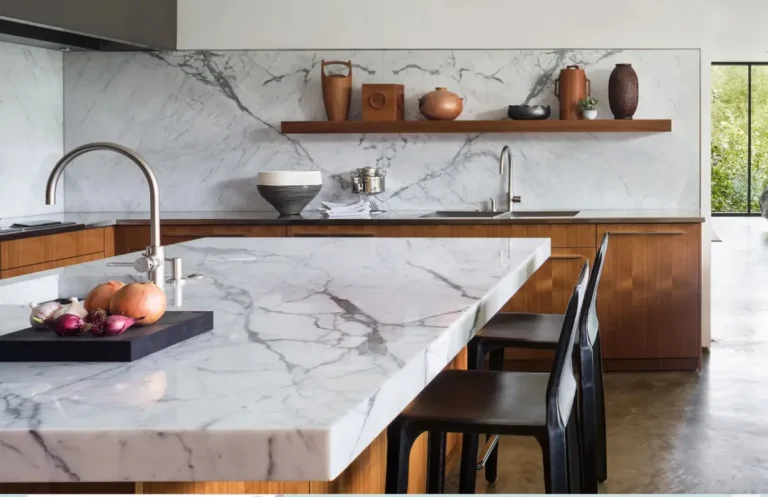
| High-End (Exotic) | Intricate marble-mimicry with deep veins; unique textures (honed/leathered). | Luxury custom homes; high-end focal points. | High |
| Architectural / Designer | Oversized slabs; rare colors; specific brand-name proprietary designs. | Commercial lobbies; luxury penthouse islands. | Very High |
Choosing between these tiers involves a trade-off between visual uniqueness and budget. Entry-level quartz offers the same structural durability as high-end quartz, as the mineral-to-resin ratio (typically 90-93% mineral) remains constant. The price variance is driven almost entirely by the technology required to create complex, natural-looking patterns and the brand’s warranty offerings.
Practical Scenarios or Thematic Applications

Scenario 1: The Suburban Kitchen Refresh
This scenario involves replacing existing laminate or tile counters with a durable quartz surface without changing the cabinetry layout.
-
Components: 30–40 square feet of mid-range quartz, eased edges, and one undermount sink cutout.
-
Steps: Professional laser templating, slab delivery to the fabrication shop, CNC cutting, and a half-day on-site installation.
-
Relevance: This is the most common application where the goal is a balance between aesthetic upgrade and cost efficiency.
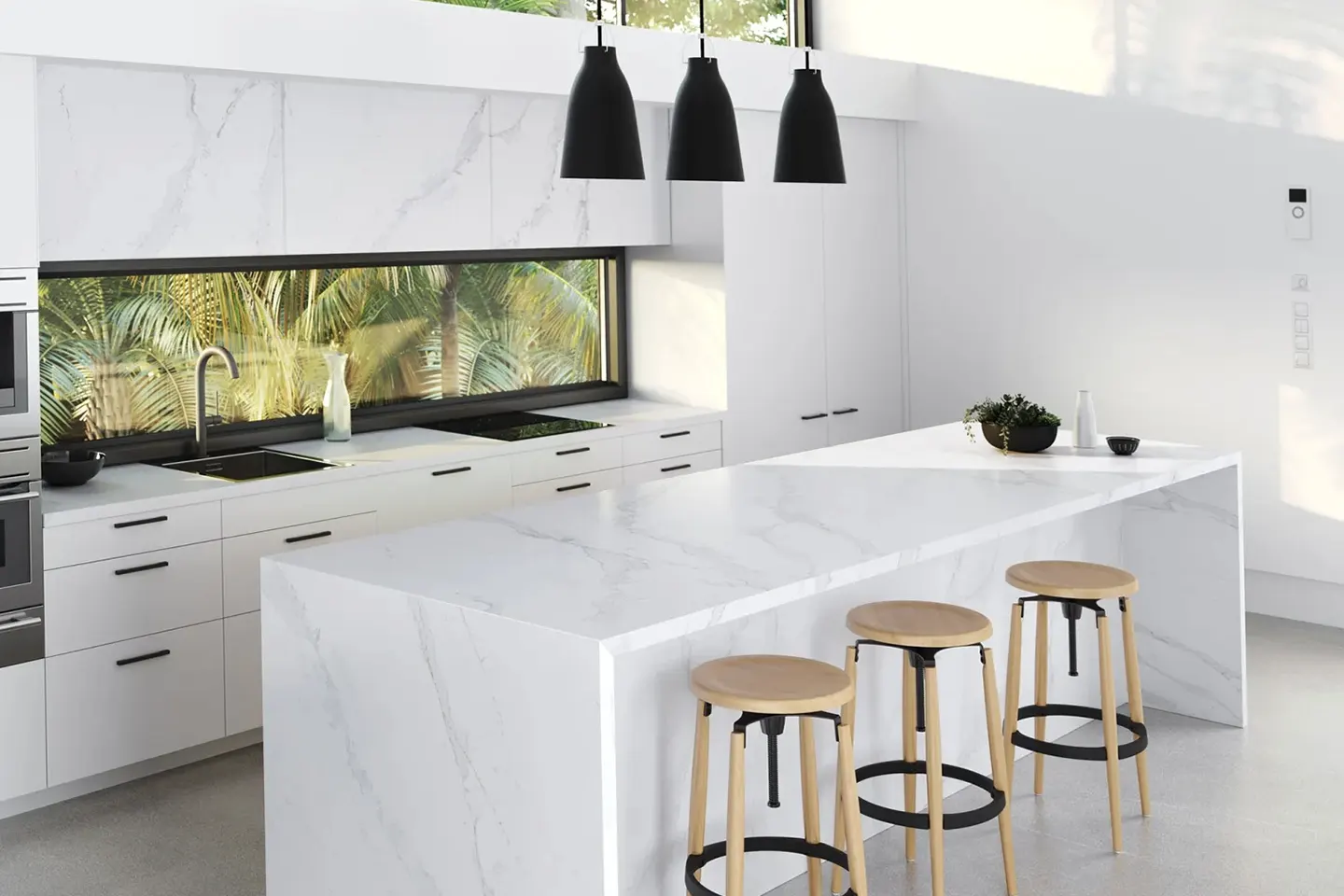
Scenario 2: The Luxury Waterfall Island
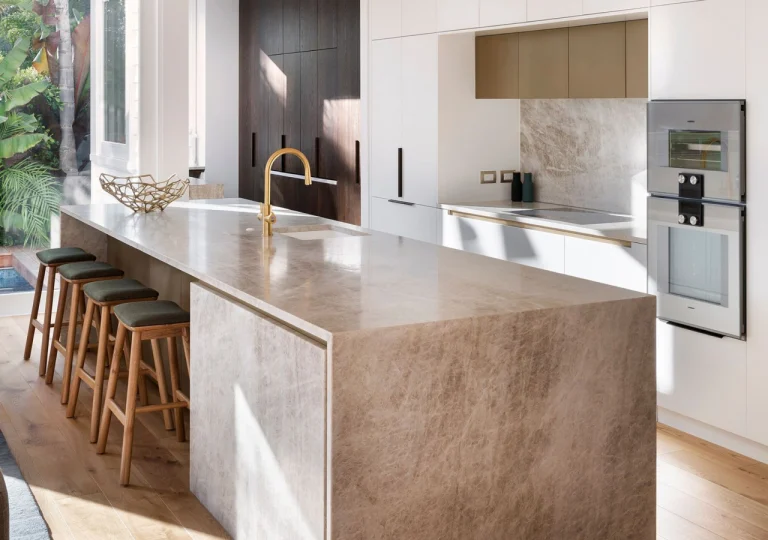
A modern architectural approach where the quartz “drops” vertically to the floor at the end of the cabinetry.
-
Components: Two exotic-tier slabs, mitered “waterfall” edges, and complex vein-matching at the joints.
-
Steps: Digital vein-mapping software usage, precision 45-degree miter cutting, and high-strength epoxy bonding on-site.
-
Relevance: This scenario significantly increases the cost of quartz countertops installed due to the extra square footage of material and the high-skill labor required for the mitered joints.
Scenario 3: The Multi-Unit Commercial Development
Focuses on standardized production for 20+ units in an apartment or hotel setting.
-
Components: Prefabricated quartz blanks, standardized sizes, and bulk-ordering discounts.
-
Steps: Use of “pre-fab” slabs (pre-cut to 26-inch widths), on-site trimming, and rapid-fire installation.
-
Relevance: This scenario suits developers who prioritize a “per-unit” cost reduction through standardization and volume.
Comparison: Scenario 1 focuses on personalized residential value; Scenario 2 prioritizes high-end design at a premium price; Scenario 3 emphasizes industrial scalability. Readers should select their path based on whether they prioritize custom aesthetics or project-wide uniformity.
Planning, Cost, and Resource Considerations

Preparation is the most significant variable in controlling the total project price. Because quartz is a “finished” product, any errors in the initial cabinetry installation will translate into higher labor costs during the countertop phase.
Sample Budget Plan (Example Figures Only)
| Category | Estimated Amount | Explanation | Optimization Tips |
| Material (Slabs) | $50 – $100 / sq. ft. | Raw cost of the engineered stone. | Choose 2cm thickness over 3cm for slight savings. |
| Fabrication Labor | $20 – $50 / sq. ft. | Cost of cutting, polishing, and sink cutouts. | Opt for a simple “Eased” or “Square” edge profile. |
| Installation | $300 – $800 total | Transport and secure placement on cabinets. | Ensure clear site access to reduce labor hours. |
| Add-ons | $200 – $500 | Sink mounting, plumbing disconnect, backsplashes. | Use tile backsplashes instead of matching quartz. |
Clearly state: Figures are examples and will vary by region, brand, and project complexity.
Strategies, Tools, and Support Options
The successful installation of quartz relies on several specialized strategies and tools that ensure the stone does not crack under its own weight.
-
Laser Templating: A digital measuring method that creates a CAD file of the cabinetry.
-
Advantages: High precision; accounts for walls that are not square.
-
Disadvantages: Adds an upfront cost to the fabrication phase.
-
-
CNC Waterjet Cutting: A computer-controlled machine that uses high-pressure water to slice the slabs.
-
Advantages: Perfect accuracy for sink holes and complex curves.
-
Disadvantages: Highly expensive machinery; requires shop-based work.
-
-
Seam Setters: Suction-based tools used on-site to pull two slabs together.
-
Advantages: Makes seams nearly invisible and perfectly level.
-
Disadvantages: Requires professional installation; cannot be used in DIY.
-
-
Plywood Sub-tops: A support layer used under 2cm quartz.
-
Advantages: Provides structural rigidity and raises the counter height.
-
Disadvantages: Increases the total material thickness at the edges.
-
Safety, Risks, and Common Challenges
-
Silica Dust Exposure: Cutting quartz releases crystalline silica dust, which is hazardous to breathe. Mitigation: Professional fabricators use “wet-cutting” methods and high-grade respiratory filtration.
-
Thermal Shock: Although resin-bound, quartz can crack if a hot pan (over 300°F) is placed directly on it. Prevention: Always use trivets or hot pads.
-
Structural Weight: Quartz weighs approximately 15–20 pounds per square foot. Risk: Weak or unlevel cabinetry can collapse or cause the stone to snap. Mitigation: Professional leveling of base cabinets prior to templating.
-
Seam Failure: Poorly placed seams (e.g., over a dishwasher or in the middle of a sink) can pull apart. Prevention: Strategic planning of seam locations during the CAD/Templating phase.
Maintenance and Long-Term Value Management
The long-term cost of quartz countertops installed is mitigated by the material’s lack of a need for sealing. Unlike granite or marble, quartz is non-porous.
-
Daily Best Practices: Use a soft cloth and pH-neutral soap. Avoid abrasive “scrubbing” pads which can dull the resin finish over time.
-
Chemical Safety: Avoid bleach, oven cleaners, or high-pH strippers. These can break the chemical bonds of the resin.
-
Regular Review: Periodically check the silicone caulking at the backsplash and sink. If the caulk fails, moisture can reach the cabinetry, leading to mold or structural rot.
Documentation and FAQ
Tips for Organizing Information:
-
Keep a record of the specific “Batch Number” of your slabs. If a piece breaks years later, having the batch number helps in finding a color-matched replacement.
-
Retain a digital copy of the CAD template provided by the fabricator for future reference.
FAQ
Q: Does the “installed” price include plumbing?
A: Usually, no. Most fabricators are not licensed plumbers. They will mount the sink to the stone, but a plumber is typically required to connect the drains and faucets.
Q: Can I save money by installing quartz myself?
A: This is generally discouraged. Due to the weight, the need for specialized diamond saws, and the risk of catastrophic cracking, the cost of a mistake often exceeds the cost of professional installation.
Q: Why is 3cm quartz more expensive than 2cm?
A: 3cm quartz is thicker and heavier, requiring more raw material and more labor for transport and installation. However, it often does not require a plywood sub-top, which simplifies the cabinetry prep.
Closing Summary
The total cost of quartz countertops installed is a reflection of both material quality and the precision of industrial fabrication. By understanding the distinction between standard and exotic tiers, and by planning for the logistical realities of heavy stone installation, property owners can make informed decisions that balance immediate aesthetics with long-term durability. While the upfront investment is significant, the absence of periodic sealing and the material’s resistance to staining offer a high value-over-time proposition for modern architectural projects.